
6-Pin vs. 7-Pin Lock Cylinders
6-Pin vs. 7-Pin Lock Cylinders
Understanding Real Security Differences
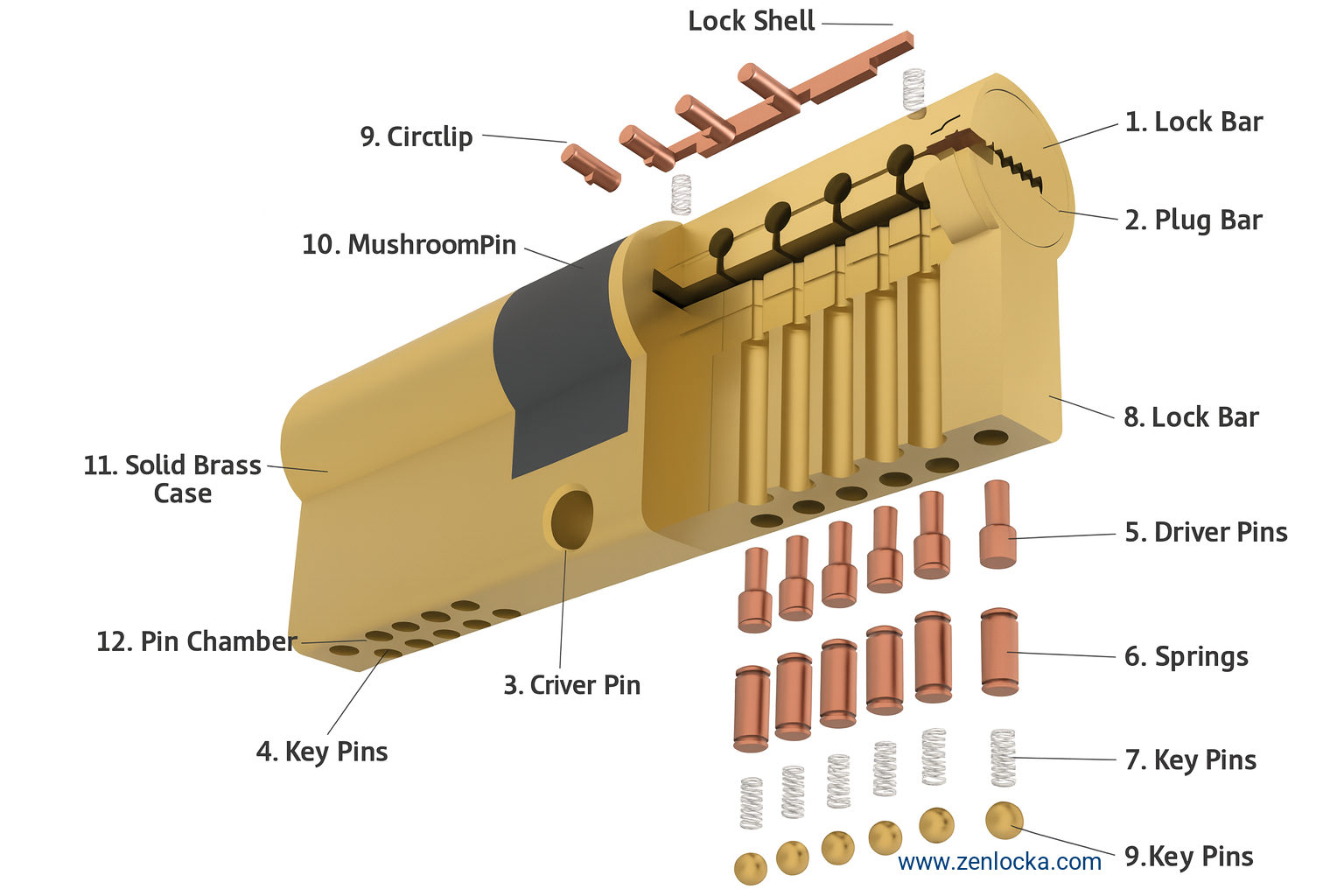
Why “7-Pin” Does Not Always Mean Higher Security
In today’s lock cylinder market, many products are promoted as “7-pin cylinders”, often implying better security than standard 6-pin designs.
However, not all 7-pin cylinders are created equal.
Some products labeled as “7-pin” do not actually have seven functional pin stacks. Instead, they are based on a traditional 6-pin structure with an additional, non-working pin hole added for appearance.
This page explains the real structural differences and helps you identify what truly improves security.
How a Pin Tumbler Lock Works
A pin tumbler lock operates based on the alignment of pin stacks at the shear line.
When the correct key is inserted:
Each bottom pin (key pin) is lifted to a precise height
The separation between top and bottom pins aligns exactly at the shear line
Only then can the plug rotate and unlock
👉 Every functional pin stack increases security by adding more combinations and resistance to manipulation.
Standard 6-Pin Lock Cylinder
Key characteristics
6 functional pin stacks
All pins actively control the shear line
6 effective key cuts
Security level
Stable and widely used
Moderate resistance to picking
No misleading structure
This is the industry baseline for mechanical cylinders.
Genuine 7-Pin Lock Cylinder (All Pins Functional)
A true 7-pin cylinder is a structural upgrade, not a cosmetic one.
What makes it genuine
7 pin stacks positioned within the plug’s rotation path
All 7 pins must align at the shear line
7 effective and functional key cuts
Security advantages
Significantly increased key combinations
Higher resistance to picking and decoding
Real improvement over 6-pin designs
✔ This is what “7-pin security” is supposed to mean.
Common “Fake” 7-Pin Cylinders on the Market
Some cylinders marketed as “7-pin” are manufactured by:
Taking a standard 6-pin cylinder
Drilling an extra pin chamber
Adding a decorative or inactive seventh pin
Typical signs
The 7th pin does not intersect the shear line
Lock operates normally even if the 7th pin is removed
The 7th key cut has little or no functional effect
❗ In practice, these locks still operate as 6-pin cylinders.
Security Comparison at a Glance
| Feature | 6-Pin Cylinder | Genuine 7-Pin | “Fake” 7-Pin |
|---|---|---|---|
| Functional pin stacks | 6 | 7 | 6 |
| Effective key cuts | 6 | 7 | 6 (7 visually) |
| Key combinations | Medium | High | Medium |
| Picking resistance | Medium | High | Medium |
| Structural honesty | ✔ | ✔ | ✖ |
How to Identify a Real 7-Pin Cylinder
For distributors and professional buyers:
Check the structure: Does the 7th pin intersect the shear line?
Examine the key: Are all cuts functionally different?
Read specifications carefully: Look for “7 functional pin stacks”
Be cautious of vague terms like “7-pin design” without clarification
Our Position on Security Design
We believe that security should be based on real structure, not marketing numbers.
A genuine 7-pin cylinder provides measurable security benefits.
A non-functional pin does not.
That’s why we clearly distinguish between:
Number of pin holes
Number of functional pin stacks
Because true security comes from how the lock works, not how it looks.
Want to Learn More?
Contact us for detailed technical drawings
Request distributor training materials
Ask about our verified 7-pin cylinder designs